
The Patient Journey in Chiropractic Marketing: From First Click to Loyal Patient
You’re running Google Ads. Your website looks professional. You’re getting traffic. So why aren’t more people booking appointments? The problem isn’t your marketing budget – it’s that you’re not thinking about the patient journey in chiropractic marketing as a complete system. According to healthcare marketing research, 77% of patients use search engines before booking an appointment, but only 3-5% of website visitors actually convert on their first visit.

At MyChiroPractice, we help chiropractic clinics across California turn clicks into patients by mapping and optimizing every touchpoint in the patient journey. Let’s break down exactly where you’re losing potential patients and how to fix it.
Why Understanding the Patient Journey Is Critical for Chiropractors
Most chiropractors focus on getting more traffic without asking the harder question: what happens after someone clicks? Here’s where the breakdown typically occurs:
Why website visitors don’t convert:
- They can’t find clear pricing or insurance information
- Your “what to expect” messaging is vague or missing
- Mobile experience is clunky (53% of healthcare searches happen on mobile)
- No clear next step after reading your homepage
The hidden trust gaps that stop bookings: Research shows that 94% of patients read online reviews before choosing a healthcare provider. If your Google Business Profile has fewer than 10 recent reviews, you’re losing trust before they even visit your site.
Where most chiropractic clinics lose patients unknowingly:
- Between the homepage and the booking page (poor navigation)
- At the booking form (too many fields, confusing layout)
- During the “consideration” phase (no nurture emails, no retargeting)
- After the first visit (no follow-up, no review request)
The 6 Core Stages of the Chiropractic Patient Journey
Stage 1 – Awareness & Discovery
Goal: Be found and make a strong first impression.
This is where someone types “chiropractor near me” or “best treatment for sciatica” into Google. If you’re not showing up in the top 3 local results or the map pack, you’re invisible.
Key marketing channels:
- Google Search & Google Maps (Local SEO): Optimize your Google Business Profile with photos, posts, and keywords
- Paid ads (Google Ads, Meta): Target pain-based searches like “herniated disc treatment” or “neck pain relief”
- Blog content: Answer real patient questions to rank organically
- Social media: Educational posts that position you as an expert
Key metrics to track: Impressions, clicks, map views, local search ranking
Stage 2 – Consideration & Trust Building
Goal: Prove credibility and reduce fear.
Once someone lands on your website, you have 8-10 seconds to convince them you’re trustworthy. Homepage clarity is everything. According to Stanford research, 75% of users judge a company’s credibility based on website design alone.
What builds trust:
- Clear homepage messaging: “We help [specific patient type] get relief from [specific condition] without surgery or drugs”
- Doctor bios with personality: Show credentials, but also why you became a chiropractor
- Video content: A 60-second welcome video converts 3x better than text alone
- Reviews & testimonials: Display them prominently above the fold
- Before/after stories: Real patient outcomes build belief
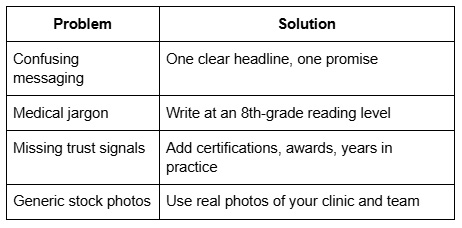
Common friction points that kill conversions:
Stage 3 – Booking the First Appointment
Goal: Make booking effortless.
Studies show that 67% of patients prefer online scheduling over calling. If your only option is “call us”, you’re losing half your potential patients to competitors with easier booking.
What works:
- Online scheduling tools embedded on every page
- Clear CTAs (Call-to-Action buttons) in the header, sidebar, and footer
- Mobile optimization: Buttons should be thumb-friendly, forms should auto-fill
- Pricing transparency: Even a range (“most visits are $50-$100”) reduces hesitation
- “What to expect” page: Walk them through the first visit step-by-step
Key metrics: Form submissions, phone calls, conversion rate (visitors to bookings)
Stage 4 – The First Visit Experience
Goal: Match marketing promises with real experience.
Here’s a brutal truth: bad first visits kill even the best ad campaigns. If your marketing promises personalized care but your front desk treats patients like numbers, they won’t come back.
What matters:
- Front desk communication: Warm greeting, clear check-in process
- Intake forms: Send them digitally before the visit to save time
- First consultation: Listen more than you talk
- Education during exam: Explain what you’re doing and why
- Report of findings: Use visuals (X-rays, models) to show the problem
Marketing insight: A 5-star first visit turns patients into reviewers and referrers. A mediocre one erases all your marketing investment.
Stage 5 – Treatment & Ongoing Care
Goal: Retention and perceived value.
The real revenue in chiropractic isn’t the first visit – it’s the care plan completion. According to industry benchmarks, the average patient lifetime value in chiropractic is $1,200-$2,400, but only if they complete their recommended care.
How to increase retention:
- Care plan communication: Written treatment plan with milestones
- Progress tracking: Show improvement with photos, measurements, or pain scales
- Educational follow-ups: Email tips between visits
- Automated reminders: SMS or email for upcoming appointments
Key metrics: Visit frequency, care plan completion rate, patient retention beyond 30 days
Stage 6 – Post-Treatment, Reviews & Advocacy
Goal: Turn patients into promoters.
This is the most neglected stage and the most profitable. Research shows that referred patients have a 16% higher lifetime value and are 4x more likely to refer others.
What to implement:
- Review request automation: Send a text or email 24 hours post-visit
- Referral incentive systems: Discount or gift for referring friends
- Reactivation campaigns: Email patients who haven’t been in for 60+ days
- Long-term nurturing: Monthly wellness tips to stay top-of-mind
Key metrics: Number of reviews, referral rate, patient lifetime value
See more: Marketing Chiropractic Locally: 7 Proven Strategies to Attract More Patients in Your Area
How to Map Your Own Chiropractic Patient Journey
Step 1 – Define Your Ideal Patient Personas
Not all patients are the same. A new injury patient has different needs than a chronic pain or wellness patient. Create 2-3 personas based on:
- Pain level and condition type
- Insurance vs cash pay
- Urgency (immediate relief vs preventive care)
Step 2 – Identify Every Marketing Touchpoint
List every place a patient interacts with your practice:
Google search → Google Business Profile → Website homepage → Conditions page → Booking form → Confirmation email → First visit → Follow-up email → Review request
Step 3 – Identify Emotional & Practical Pain Points
At each touchpoint, ask:
- What questions do they have?
- What fears or objections exist?
- What’s stopping them from moving forward?
Common pain points include fear of cost, fear of pain during treatment, confusion about insurance, and skepticism about results.
Step 4 – Optimize Each Stage With Clear Actions
Quick wins for fastest ROI:
- Add online scheduling (increases conversions by 40%)
- Request 10+ Google reviews (boosts trust instantly)
- Create a “What to Expect” page (reduces anxiety)
- Set up automated appointment reminders (decreases no-shows by 30%)
Final Thoughts
Here’s what changes when you start thinking in terms of the patient journey in chiropractic marketing: you stop throwing money at random ads hoping something sticks. Instead, you build a system where every touchpoint – from the first Google search to the sixth adjustment – is optimized to move people forward.
As Digital Marketing Experts for Chiropractor practices, we’ve seen clinics double their patient acquisition simply by fixing friction points they didn’t even know existed. The breakthrough isn’t spending more on marketing – it’s understanding where you’re losing people and plugging those leaks.
Ready to map your patient journey and turn more clicks into loyal patients? Contact MyChiroPractice today. We’ll audit your current marketing, identify where you’re losing patients, and build a conversion system that turns your practice into a patient growth machine.