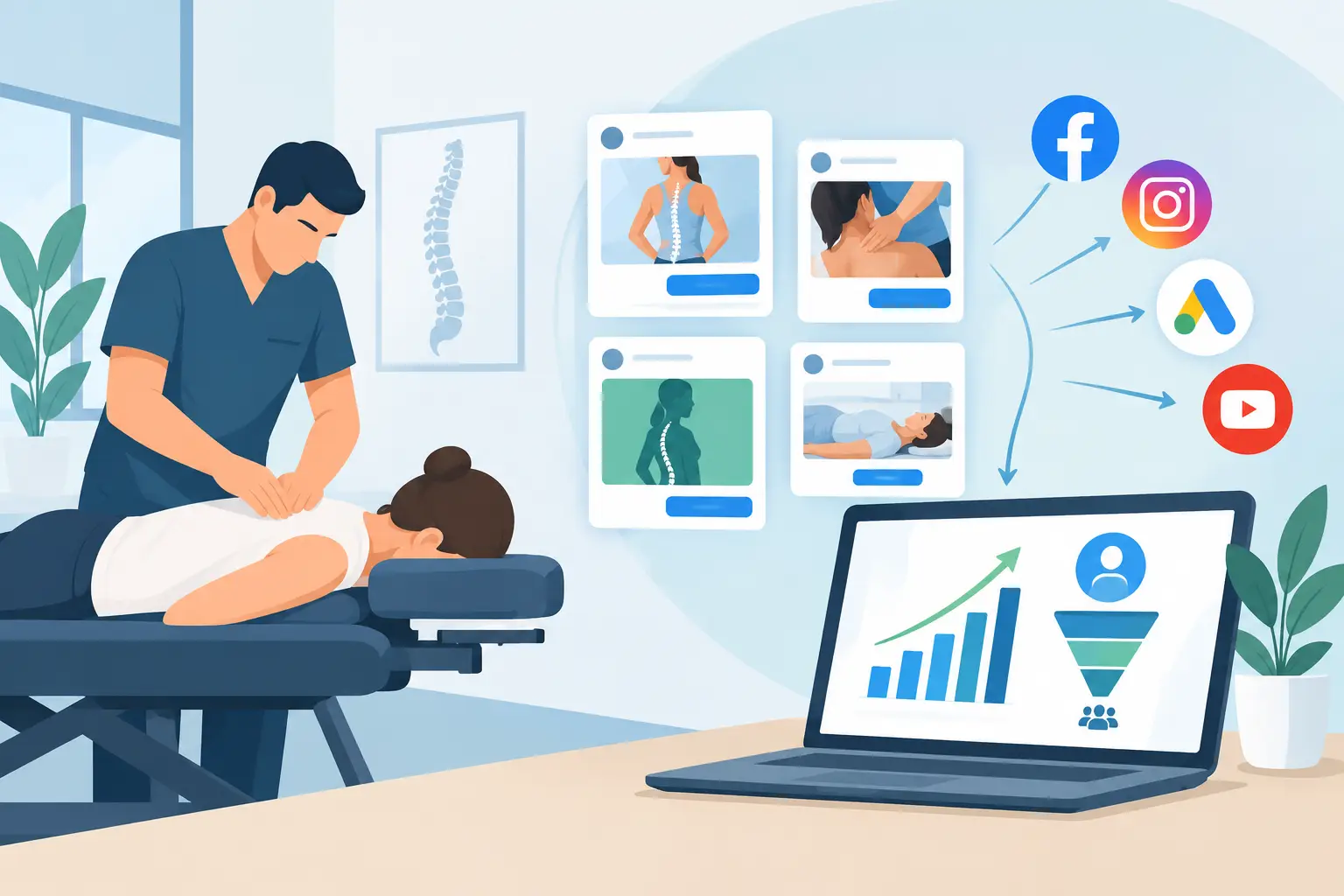
A prospective patient has lower back pain on a Tuesday night. They search Google, compare three nearby chiropractors, scan reviews, visit a website, and decide within minutes whether to call, book, or keep looking. That decision is the real battleground for your patient acquisition funnel. If your clinic is hard to find, hard to trust, or hard to contact, the patient does not wait for a better explanation. They choose your competitor.
For chiropractic practices, growth is not about generating more clicks in isolation. It is about building a connected path that moves the right local prospect from pain and uncertainty to a scheduled first visit, a positive in-office experience, and a reason to return. When that path has gaps, paid advertising gets expensive, organic rankings produce fewer calls, and staff spend too much time chasing leads that should have converted on their own.
What a Patient Acquisition Funnel Means for Chiropractors
A patient acquisition funnel is the system that turns local demand into new patients. It begins before someone knows your clinic exists and continues well after the first adjustment. The funnel is not a generic marketing diagram. It is the practical relationship between your visibility, brand, website, front desk, clinical communication, and retention process.
A prospective patient may enter through a Google search for “chiropractor near me,” a Google Business Profile, a referral, a Facebook ad, a video, or a neighborhood recommendation. Their channel matters, but their questions are usually the same: Can this doctor help with my problem? Is this practice credible? Is it close and convenient? What will happen at the first visit? Can I trust them?
Your marketing must answer those questions faster and more convincingly than the clinics competing for the same patient. A high-performing funnel gives people a clear next step at every stage. A weak one forces them to interpret vague claims, hunt for contact information, or wonder whether your practice is right for them.
The 5 Stages That Drive New Patient Volume
1. Local visibility: Be present when demand appears
The first stage is demand capture. Patients rarely wake up wanting to engage with a chiropractic brand. They want relief, answers, mobility, or a clinician who takes their concern seriously. Your practice must appear at the moment they begin searching.
That requires a strong local search presence, a well-managed Google Business Profile, useful service pages, credible reviews, and paid search coverage for high-intent terms when the market demands it. In competitive areas, relying on one channel is a gamble. Organic search can build durable visibility, while Google Ads can create immediate lead flow. The right mix depends on your market, reputation, budget, and how quickly you need to grow.
Visibility without differentiation is not enough. If every nearby practice says “quality care” and “personalized treatment,” patients see a row of interchangeable options. Your positioning needs to show why your clinic is worth choosing.
2. Trust: Give the patient a reason to choose you
A click is not a lead. Once a prospect reaches your website or profile, they assess your credibility in seconds. Professional design, clear messaging, authentic reviews, doctor photography, patient-friendly explanations, and proof of local relevance all influence whether they take action.
This is where many chiropractic websites lose revenue. They may look acceptable, but they are built like online brochures rather than conversion tools. They bury appointment options, use generic stock imagery, lead with clinical jargon, or fail to explain what makes the practice different.
The best-performing practices communicate a focused promise. Maybe they are known for family chiropractic, injury recovery, prenatal care, sports performance, corrective care, or a premium patient experience. The promise must be specific enough to be memorable while remaining honest about the care you provide. Broad messaging can attract more traffic, but focused messaging often converts higher-quality patients.
3. Conversion: Make booking feel easy and low-risk
The conversion stage is where interest becomes a phone call, form submission, text conversation, or online appointment. Every unnecessary obstacle reduces your lead volume.
A conversion-focused page should make it obvious what the patient should do next. Prominent calls to schedule, click-to-call functionality, concise forms, online booking where appropriate, and clear first-visit expectations reduce hesitation. Your contact options should work flawlessly on mobile, because many patients search and decide from their phones.
Do not confuse more options with a better experience. A page crowded with competing buttons, long paragraphs, pop-ups, and unrelated offers can create friction. One primary action is usually stronger: schedule a new patient visit, request an appointment, or call the clinic now.
Offer strategy requires judgment. A discounted exam or new-patient special can increase response volume, particularly with paid ads. But it may also attract price-sensitive leads who are less likely to follow through with care. In some markets, a strong authority message and an exceptional first-visit experience outperform aggressive discounting. Track results by kept appointment and patient value, not just form-fill cost.
The Patient Acquisition Funnel Does Not End at the Appointment
Getting an appointment on the calendar is a milestone, not a finish line. The most expensive lead is the one your front desk does not reach, the patient who no-shows, or the new patient who never understands the value of ongoing care.
Speed matters. A lead who submits a form at 10:00 a.m. may contact another office by 10:15. Establish a clear follow-up standard for calls, forms, texts, and missed calls. Your staff needs scripts that sound human, not scripted: acknowledge the patient’s concern, answer the immediate question, explain the next step, and confidently ask for the appointment.
Then connect your marketing promise to the actual clinic experience. If your ads present a modern, attentive, premium practice, the first visit must reinforce that expectation. A confusing intake process, a rushed consultation, or inconsistent communication can erase the trust your marketing worked to earn.
Patient education is a major retention lever in chiropractic. People are more likely to continue care when they understand their condition, their care plan, what progress may look like, and why consistency matters. Educational visuals, spine charts, in-office TV content, and well-designed handouts can support the doctor’s communication without replacing it. They make complex conversations easier to remember after the patient leaves.
Retention improves acquisition economics
A clinic with strong retention can afford to invest more confidently in acquisition because each new patient has greater long-term value. A clinic with poor retention often believes it has a lead problem when it actually has an expectation-setting or patient-education problem.
This does not mean every patient should follow the same care path. Clinical needs, goals, insurance constraints, scheduling realities, and patient preferences vary. It means your practice should have a consistent process for communicating recommendations, reinforcing progress, and making reactivation appropriate when patients fall out of care.
Measure the Numbers That Reveal the Real Problem
Marketing decisions get better when you follow the patient journey instead of celebrating vanity metrics. Website traffic, social followers, and ad impressions can indicate reach, but they do not tell you whether the practice is growing profitably.
Track the chain from source to outcome: calls and form leads, contact rate, scheduled appointments, show rate, new patients seen, accepted care plans where applicable, retention, reactivations, and estimated patient value. Review results by channel. Google Ads may create a different type of lead than referrals or local SEO, and that is useful information.
If leads are high but booked visits are low, your response process or offer may be the problem. If appointments are high but no-shows rise, reminders and front-desk confirmation need attention. If new patient volume is strong but revenue does not follow, look at the in-office experience and retention communication before simply buying more advertising.
This level of visibility turns marketing from an expense into an operating system. It also protects your budget. You can scale what produces kept appointments and stronger patient relationships, then correct the weakest stage before competitors take more of your market.
Build a Funnel Your Competitors Cannot Easily Copy
Your competitors can copy an ad headline. They can bid on similar keywords and post similar social content. What is harder to copy is a complete system: recognizable branding, high local visibility, a persuasive website, disciplined lead handling, an exceptional patient experience, and educational materials that reinforce care inside the clinic.
That is the advantage MyChiroPractice helps chiropractic practices build. The goal is not random marketing activity. The goal is a clinic that earns attention, converts demand, and creates the patient confidence required for sustained growth.
Start by finding the biggest leak in your funnel. It may be visibility, trust, booking, follow-up, or retention. Fixing that one constraint can create more growth than another month of disconnected posts or another round of generic advertising. The practices that lead their markets do not leave the patient journey to chance.