
Branding for Chiropractors: How to Stand Out in a Crowded Local Market
There are probably five other chiropractors within three miles of your practice. Maybe more.
They offer adjustments. You offer adjustments. They treat back pain. You treat back pain. On paper, you all look the same and that’s the problem.
Branding for chiropractors isn’t about having a nice logo or clever tagline. It’s about creating a distinct identity that makes patients choose you over every other option. It’s the difference between being “a chiropractor” and being “their chiropractor”.
Let’s walk through exactly how to build chiropractic practice branding that attracts ideal patients, commands premium pricing, and creates lasting competitive advantages.

Step 1: Build a Strong Chiropractic Brand Foundation
Every lasting brand starts with clarity. Without a solid foundation, your marketing efforts scatter and your message confuses.
Clarify Your Purpose & Practice Philosophy
What does your practice truly stand for? This isn’t about listing services – it’s about defining your core mission.
Common positioning approaches:
- Wellness-focused – Proactive health optimization for families
- Injury recovery – Getting active individuals back to peak performance
- Sports performance – Enhancing athletic function and preventing injury
- Corrective care – Long-term structural correction over symptom relief
Your philosophy shapes everything from the treatments you offer to the patients you attract. Trying to be everything to everyone weakens your brand positioning.
Define Your Unique Value Proposition (UVP)
Here’s the hard truth: “We provide quality care” isn’t a UVP. Neither is “We treat the whole person” or “We care about our patients.”
Your UVP should answer:
- What makes your clinic genuinely different in your local market?
- What specific outcomes, techniques, or approaches set you apart?
- Why should someone drive past three other chiropractors to reach you?
Generic claims fail because they’re forgettable. Specific positioning sticks. For example: “The only CBP-certified clinic in [city] specializing in posture correction” or “Sports injury recovery for weekend warriors and competitive athletes.”
Understand Your Ideal Patients
Chiropractic clinic branding requires knowing exactly who you serve.
Define your patient groups:
- Primary audience – Your absolute best-fit patients (demographics, conditions, values)
- Secondary audience – Additional patient types you serve well
- Emotional drivers – What motivates their healthcare decisions (fear, performance, prevention, pain relief)
When your ideal patient is unclear, your brand lacks focus. You end up with generic messaging that appeals to no one specifically and therefore attracts no one consistently.
Step 2: Create a Visual Identity That Builds Instant Trust
Your visual brand communicates before you say a word. First impressions form in seconds.
Logo, Colors & Design Psychology in Healthcare Branding
The visual credibility balance:
Healthcare branding requires walking a fine line between medical credibility and approachability. Too clinical it feels cold. Too casual undermines trust.
Color psychology matters:
- Blues – Trust, professionalism, calm (most common in healthcare)
- Greens – Health, wellness, growth
- Neutrals – Sophistication, clarity, premium positioning
- Avoid – Overly bright colors that feel unprofessional
Common visual branding mistakes chiropractors make:
- Generic clip-art logos that look dated
- Inconsistent font choices across materials
- Stock photos that don’t match their actual practice
- Color schemes that clash or confuse
See more: The Ultimate Guide to Branding for Chiropractors: Going Beyond Just a Logo
Maintain Consistency Across All Brand Touchpoints
Your brand appears everywhere patients encounter you:
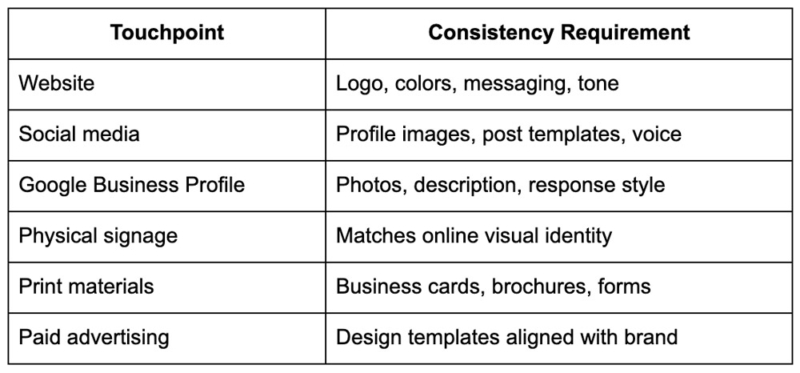
Why inconsistency destroys credibility:
When your Instagram looks modern but your website looks 10 years old, patients notice. When your Google listing promises a certain experience but your office delivers something different, trust breaks immediately.
Consistency doesn’t mean boring – it means reliable and professional.
Step 3: Develop Clear Brand Messaging & Voice
Speak in Your Patients’ Language
Most chiropractors talk in chiropractic terms. Most patients think in outcomes.
Translation examples:
- Instead of: “We provide spinal adjustments and corrective care”
Say: “We help desk workers eliminate chronic neck pain and prevent future problems”
- Instead of: “We use evidence-based manual therapy techniques”
Say: “We get athletes back to peak performance without surgery or downtime”
Match messaging to patient mindset:
- Skeptical patients need education, proof, and realistic expectations
- Wellness-focused patients respond to prevention and optimization language
- Pain-driven patients want immediate relief and clear timelines
Define Your Brand Voice & Tone
Your brand voice is your personality in words. It should remain consistent everywhere.
Common chiropractic brand voice options:
- Professional & authoritative – Builds credibility through expertise
- Friendly & approachable – Emphasizes comfort and patient relationships
- Educational & transparent – Positions practice as trusted advisor
- Results-focused & direct – Appeals to action-oriented patients
Where voice consistency matters most:
- Website copy and service descriptions
- Social media posts and captions
- Staff communication (phone, front desk, email)
- Review responses and patient follow-ups
- Advertising and promotional materials
When your website sounds corporate but your social media sounds casual, patients sense the disconnect. Choose one voice and maintain it.
Craft a Compelling Chiropractic Brand Story
Stories humanize your brand and create emotional connections.
Elements of effective practice stories:
- Origin – Why you became a chiropractor or started your practice
- Mission – What drives your daily work beyond profit
- Patient impact – Real transformations you’ve facilitated (ethically shared)
- Values – What matters most in how you practice
What makes stories work:
- Authenticity over polish
- Specific details over vague claims
- Outcomes over techniques
- Honesty about limitations and realistic expectations
Stories that overpromise or sound too perfect damage trust. Authentic stories that acknowledge challenges while highlighting genuine results build it.
Step 4: Strengthen Your Online Brand Presence
Website Branding That Converts Visitors Into Patients
Your website is your digital storefront. The first five seconds determine whether visitors stay or leave.
Above-the-fold essentials:
- Clear headline stating who you serve and what you solve
- Supporting subheadline expanding on your unique approach
- Strong call-to-action (book now, free consultation, etc.)
- Professional hero image reflecting your actual practice
Messaging hierarchy for clarity:
- Primary message – Your core promise (headline)
- Supporting benefits – Why patients should choose you
- Social proof – Reviews, credentials, results
- Clear next steps – Frictionless path to booking
When visual design and copy messaging align perfectly, conversion rates soar. When they conflict, patients get confused and leave.
Local Branding & Community Authority
Your Google Business Profile is a branding asset, not just a directory listing.
Optimize for local brand recognition:
- Complete profile with consistent NAP (name, address, phone)
- High-quality photos of your actual practice and team
- Regular posts demonstrating expertise and community involvement
- Strategic review generation and professional responses
Becoming “the chiropractor” in your city requires:
- Proximity optimization for search visibility
- Reputation signals through consistent positive reviews
- Community engagement (events, partnerships, local content)
- Brand mentions across local directories and platforms
Local chiropractor branding means being the obvious choice when someone in your area needs chiropractic care.
Step 5: Build Brand Authority Through Content & Social Proof
Authority accelerates trust. Content and proof work together.
Educational Content That Builds Authority
Effective chiropractic content marketing includes:
- Blog articles answering common patient questions
- Educational videos demonstrating exercises or explaining conditions
- FAQ sections addressing concerns and misconceptions
- Social media posts that teach without selling
The teaching vs selling balance:
Education positions you as an expert. Selling positions you as a vendor. Lead with teaching – conversions follow naturally when trust is established.
Content that reinforces brand authority:
- Condition-specific guides showing deep expertise
- Patient success stories (with permission and compliance)
- Evidence-based explanations of your approach
- Transparent discussions of what works and what doesn’t
Reviews, Testimonials & Patient Stories
Reviews aren’t just SEO tools – they’re powerful branding assets.
Strategic chiropractor reputation management:
- Systematic review generation from satisfied patients
- Public responses that reflect brand voice and values
- Addressing negative reviews professionally and constructively
- Showcasing testimonials across marketing materials
Ethical patient storytelling guidelines:
- Always obtain written permission
- Focus on experience and journey, not just outcomes
- Avoid making claims that violate HIPAA or FTC guidelines
- Present realistic expectations, not miracle cures
Chiropractic patient reviews serve as social proof that your brand delivers on its promises. They validate your messaging and reduce perceived risk for new patients.
Step 6: Align the In-Clinic Experience With Your Brand
Your brand lives in every patient interaction, not just your marketing.
Where brand consistency matters offline:
Front desk communication:
- Phone scripts reflecting brand voice and tone
- Greeting style matching online personality
- Appointment scheduling experience aligned with brand promises
Patient onboarding experience:
- First-visit process that feels organized and professional
- Educational materials reinforcing brand messaging
- Staff interactions consistent with brand values
Follow-up and care delivery:
- Treatment explanations in brand language
- Patient communication maintaining brand tone
- Delivering exactly what your marketing promised
The brand promise gap:
When marketing promises one experience but the clinic delivers another, patients feel deceived. When both align perfectly, loyalty and referrals skyrocket.
As Chiropractor Marketing Experts in California, we’ve seen practices transform simply by ensuring their in-clinic experience matches their brand identity.
Final Thoughts: Building a Chiropractic Brand That Lasts
Branding for chiropractors isn’t a marketing tactic – it’s a strategic business asset that compounds over time.
Ready to build a brand that attracts ideal patients and commands premium positioning? At Mychiropractice, we specialize in helping chiropractic practices develop strategic brands that stand out in competitive local markets. Let’s create a brand identity that turns your practice into the obvious choice – not just another option.