
Entity SEO for Chiropractors: A Practical Guide | My Chiropractic
Entity SEO for chiropractors helps search engines understand who you are, where your practice is located, and what services you provide. Instead of focusing only on keywords, it helps connect your clinic, doctors, services, and location into a clear online identity.
At MyChiroPractice, we help chiropractic practices strengthen their online presence through advanced SEO and digital marketing. Understanding entity SEO is an important step toward making your practice easier for search engines to recognize.

What is entity SEO for chiropractors?
Entity SEO is the process of making your business identity and its connections clear to search engines.
An entity is something that can be identified, such as a business, person, place, or organization. For chiropractors, your practice is an entity connected to your doctors, services, and physical location.
Traditional keyword SEO focuses on matching content with search terms. Entity SEO focuses on helping search engines understand what those terms refer to.
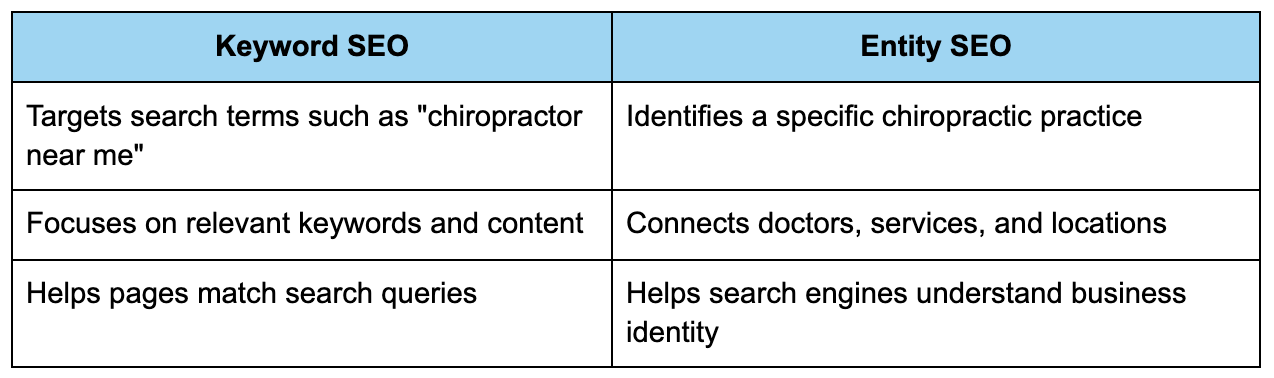
Both approaches work together. Keywords help search engines understand what people are looking for, while entity information provides context about your practice.
How search engines understand your chiropractic practice
Search engines gather information from websites, business profiles, structured data, and other online sources to identify businesses and their relationships.
For a chiropractic practice, these connections may include:
- Practice: Your official business name and website.
- Chiropractors: Doctors who work at your clinic.
- Credentials: Professional qualifications, degrees, and licenses.
- Services: Chiropractic adjustments, spinal decompression, or other treatments you actually provide.
- Location: Your physical address, neighborhood, and geographic service area.
For example, a chiropractic clinic in Newport Beach may be associated with a licensed chiropractor who provides spinal decompression at that location. These relationships help search engines distinguish one practice from another.
Google uses systems such as its Knowledge Graph to organize information about entities and their connections. Clear, consistent information can help search engines identify your practice and understand its relationships. However, this does not guarantee a Google Knowledge Panel.
Why entity SEO matters for chiropractic practices
Entity SEO supports a clearer online identity, which can benefit your broader chiropractic marketing strategy.
- Clear business identity: Consistent information helps search engines recognize your practice across different platforms. It also helps patients confirm they have found the right clinic.
- Local search understanding: Connecting your practice with its location and services helps search engines understand your business in a local context. This may support your visibility in relevant local searches.
- AI search visibility: Clear, accurate information helps AI search systems understand your practice and its services, although it does not guarantee inclusion in AI generated answers.
Entity SEO works alongside content quality, technical SEO, and other search signals to support your overall online presence.
How to optimize entity SEO for your chiropractic practice
Building a strong business entity starts with accurate information. You do not need complicated tools to begin, but you should make sure every platform presents the same practice identity.
Here are six practical steps to optimize your clinic’s online identity.
1. Establish a consistent business identity
Start with your practice’s basic information, which includes your name, address, and phone number.
Check that these details are accurate and consistent across your website, Google Business Profile, and other business listings.
You should also review your website URL, business hours, and official practice name.
If your clinic moves or changes its phone number, update the information across your online profiles promptly. Consistency helps prevent confusion about which business each listing represents.
2. Optimize your Google Business Profile
Your Google Business Profile provides important information about your practice in Google Search and Maps.
Make sure your profile includes:
- Business name: Use your actual practice name without adding unnecessary keywords.
- Primary category: Select “Chiropractor” if it best describes your business.
- Address: Provide your correct physical location.
- Business hours: Keep your operating hours current, including holiday adjustments.
- Services: List the specific chiropractic treatments you actually offer.
- Website: Link to your official practice website.
Review your profile regularly, especially after making changes to your services, staff, or clinic location.
3. Implement relevant schema markup
Schema markup helps search engines understand your website’s content. For chiropractic practices, relevant Schema.org types and properties include:
- Chiropractor: Identifies a chiropractic business.
- MedicalBusiness: Describes a healthcare business.
- Person: Identifies individual chiropractors and their credentials.
- sameAs: Connects your practice or doctors to their official online profiles.
Include accurate business details such as your name, address, phone number, and website. Follow Google’s Local Business structured data guidelines and use sameAs only for profiles representing the same entity.
Schema markup helps clarify your business information but does not guarantee higher rankings or rich results.
4. Create clear doctor and practice profiles
Your website should clearly explain who operates your practice and who provides care to patients.
A complete About page can include your practice’s history, mission, location, and core services.
Individual doctor profiles should provide:
- Full professional name with credentials.
- Education, degrees, and qualifications.
- Relevant state licenses or certifications.
- Areas of clinical experience and specialties.
- Specific services provided at the practice.
Keep these details accurate and updated.
Clear professional profiles help patients understand who is responsible for their care while giving search engines more context about the people associated with your business.
5. Build accurate business citations
Business citations are online mentions of your practice’s name, address, and other identifying information.
These may appear on local business directories, professional association websites, and relevant healthcare directories.
When building citations, focus on:
- Accurate contact information: Keep your business details consistent across platforms.
- Updated listings: Correct outdated information from previous locations.
- Duplicate profiles: Remove or resolve duplicate listings when appropriate.
- Relevant directories: Choose reputable sources related to your practice.
You do not need to be listed in every directory. Prioritize sources that are accurate, useful, and relevant to your practice.
6. Connect your services, doctors, and locations
Your website structure should show how its pages relate to your practice.
For example, a spinal decompression service page can connect to your practice information, the relevant location page, and a specific doctor profile when appropriate.
This creates a clearer relationship between your business and the treatments it provides.
Internal links also help visitors navigate related information smoothly.
A connected website structure supports topical authority for AI search by organizing relevant content around your practice’s actual expertise.
The goal is to create useful semantic connections, not simply add more links or repeat keywords.
Common entity SEO mistakes to avoid
Even small inconsistencies can make your practice information harder for search engines to understand.
Watch for these common mistakes:
- Inconsistent business information: Different addresses, phone numbers, or business names across platforms can create confusion about your practice.
- Duplicate business listings: Multiple profiles for the same practice can create conflicting information and make your business harder to identify.
- Unlinked doctor profiles: Practitioner bios lack relevant connections to their professional credentials, services, or practice information.
- Outdated schema markup: Website information changes, but the structured data still contains old business details.
Reviewing these details regularly helps maintain a clear and accurate online identity.
Shaping the future of your practice
Building a clear digital identity helps your chiropractic practice maintain accurate, consistent information as search technology evolves.
When search engines can better understand the relationships between your doctors, location, and services, your practice has a stronger foundation for its online presence.
At MyChiroPractice, we focus on building clear, professional digital foundations through chiropractic SEO, website optimization, and content strategy.
If you want to review your practice’s online visibility and explore ways to strengthen your digital identity, schedule a consultation with our team to discuss your marketing goals.
Frequently asked questions
What is a chiropractic entity in search engine terms?
A chiropractic entity is a practice identified by its business name, doctors, services, and location. This information helps search engines recognize your clinic.
How does entity SEO help a clinic appear in AI search results?
Entity SEO helps AI search systems understand your practice through clear, consistent business information. However, it does not guarantee AI search visibility.
How long does it take for search engines to recognize a new chiropractic entity?
There is no fixed timeline. It depends on how quickly search engines discover and process your practice’s information.