
How to Build Topical Authority for AI Search | My Chiropractic
Building topical authority for AI search means becoming a clear, trusted source on the topics your business knows best. It is not about publishing more articles or repeating keywords.
For chiropractic practices, the goal is to answer important patient questions, connect related topics, and demonstrate real expertise. At MyChiroPractice, we use this approach to strengthen visibility across traditional and AI driven search.

What is topical authority in AI search?
Topical authority is the depth and credibility a website builds around a specific subject. In AI search, strong topical coverage can help search systems understand what your website is about and how different pieces of information relate.
For example, publishing one article about sciatica gives a search system limited context. A website that covers sciatica symptoms, causes, daily activities, treatment options, chiropractic care, and spinal decompression provides a much clearer picture of its subject coverage.
The goal is not to repeat the same keyword across dozens of pages. It is to build a useful network of information around a defined topic.
Topical depth + clear connections + real expertise + trust = stronger topical authority.
Why topical authority matters for AI search
AI search can explore a question beyond the exact words a person enters.
Google explains that its AI search experiences may use a technique called query fan out, issuing related searches across subtopics and data sources to develop a response. This means a question such as “Can a chiropractor help with sciatica?” may connect with symptoms, causes, treatment options, spinal health, and other related concepts.
Comprehensive topic coverage gives a website more opportunities to provide relevant information across those related questions.
That makes topical authority bigger than ranking one page for one keyword. It is about building useful coverage across an entire subject.
How to build topical authority for AI search
Building topical authority requires a clear structure. Instead of publishing isolated articles, we recommend developing a connected system around the topics that matter most to the practice.
1. Define the topics your practice should own
Start with real expertise rather than search volume alone.
For a chiropractic practice, core topics could include:
- Sciatica
- Spinal decompression
- Scoliosis
- Prenatal chiropractic care
- Sports chiropractic
- Neck and back pain
Then consider the services you provide, conditions you commonly address, and questions patients ask before seeking care.
You do not need to cover every health topic. A focused website with deep coverage of several relevant subjects can establish a clearer identity than one that publishes broadly about unrelated health issues.
2. Build a topic map before creating content
A topic map organizes the concepts and questions surrounding a core subject.
This goes beyond creating a keyword list.
For example:
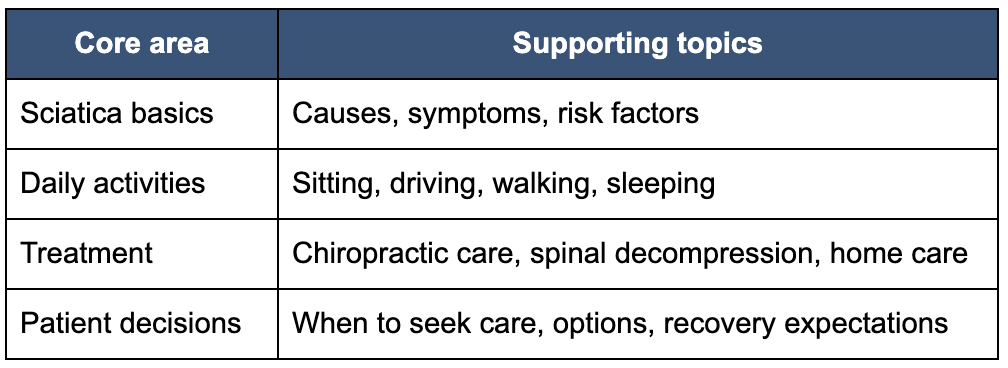
This structure helps us see what a person may want to know before, during, and after researching the main topic.
It also exposes content gaps. Instead of asking what keyword to target next, ask what important part of the subject your website has not answered yet.
3. Create pillar pages and supporting content clusters
Once you understand the topic, organize related content around a central resource.
A pillar page covers the broader subject. Supporting articles answer narrower questions.
For example, a spinal decompression pillar could connect with articles about herniated discs, sciatica, treatment expectations, candidacy, and related treatment options.
The supporting pages should also connect back to the broader subject where relevant.
This turns separate blog posts into a content ecosystem. A strong chiropractic blogging strategy should therefore consider how every article supports the website’s larger subject coverage instead of treating each post as a separate SEO asset.
4. Connect related pages with internal links
Internal links show how information on your website connects.
An article about sciatica symptoms might link naturally to content about treatment. A herniated disc article may connect to a spinal decompression service page when that relationship is relevant.
Use anchor text that describes what the linked page covers. Avoid adding links simply because two pages use similar keywords.
A good internal link should help the reader answer the next logical question.
This also creates clearer paths between conditions, symptoms, services, treatments, locations, and doctor expertise across the website.
5. Add real expertise to your content
AI can summarize information that already exists online. A chiropractic practice has something more valuable to contribute: real professional experience.
That may include:
- Doctor reviewed explanations
- Common questions heard from patients
- Original images or videos
- Clear descriptions of the treatment process
- Author and reviewer credentials
- Insights from the practice
- Reliable sources for health claims
Google’s guidance on helpful content emphasizes original information, substantial value, and first hand expertise where relevant.
This is why our approach to AI powered chiropractic marketing should not depend on generating large amounts of generic content. AI can support the process, while the practice’s knowledge provides the experience and context that make the content useful.
6. Fill content gaps instead of publishing randomly
More content is not always better.
Review each topic cluster and identify what is missing. Look for unanswered patient questions, important concepts without dedicated pages, outdated information, and pages that target almost the same intent.
Also check whether related pages are properly connected.
This changes the goal from “publish four articles this month” to “make this topic more complete.”
That distinction matters because topical authority grows through useful coverage, not simply publishing frequency.
7. Strengthen authority beyond your content
Your articles are only one part of the picture.
Clear doctor profiles, professional credentials, accurate business information, relevant citations, local profiles, and legitimate mentions can provide additional context about who is responsible for the content.
The goal is not to collect as many backlinks or mentions as possible. Focus on signals that accurately reflect the practice, its people, and its expertise.
How to measure topical authority and AI visibility
There is no official Google topical authority score.
Instead of searching for one number, measure how the entire topic performs.
Look at organic impressions across related pages, growth in relevant non branded queries, the number of cluster pages receiving search visibility, engagement with informational content, and conversions that begin with those pages.
Google Search Console can help show whether visibility is expanding across a subject rather than only improving for one article.
Where reliable data is available, you can also monitor referral traffic and citations from AI search experiences.
The important question is not whether one page ranks first. It is whether your website is becoming more visible across the subject as a whole.
Build authority around what your practice knows best
Building topical authority for AI search is not about publishing everything. It is about becoming a useful and credible source within the subjects your practice understands best.
That requires focused topics, complete content clusters, meaningful internal links, and real professional expertise.
At MyChiroPractice, we bring chiropractic SEO, content strategy, website structure, and AI search visibility together rather than treating them as separate tactics. Practices that want to strengthen this foundation can contact us to discuss their current search strategy.
Frequently asked questions
How many articles do you need to build topical authority?
There is no fixed number. The goal is to cover a topic thoroughly enough to answer important user questions. A small collection of useful, connected pages can be stronger than dozens of thin articles.
How long does it take to build topical authority?
There is no universal timeline. Competition, existing website authority, content quality, crawlability, and the size of the topic can all affect progress. Topical authority should be treated as a long term strategy.
Can a small chiropractic website build topical authority?
Yes. A smaller practice can focus deeply on the services, conditions, and patient questions it knows best. A narrow focus can make the website’s subject expertise clearer.
Do internal links help build topical authority?
Yes. Relevant internal links help users and search engines discover related pages and understand connections between topics. They work best when the linked page genuinely helps answer the reader’s next question.
Does schema markup create topical authority?
No. Schema can help search engines understand structured information about a page or entity, but it does not replace content depth, expertise, or meaningful relationships between pages.
Is topical authority important for ChatGPT and AI Overviews?
Strong, credible topic coverage can make website content more useful and discoverable across search experiences. However, topical authority does not guarantee that ChatGPT, Google AI Overviews, or another AI system will cite a particular page.