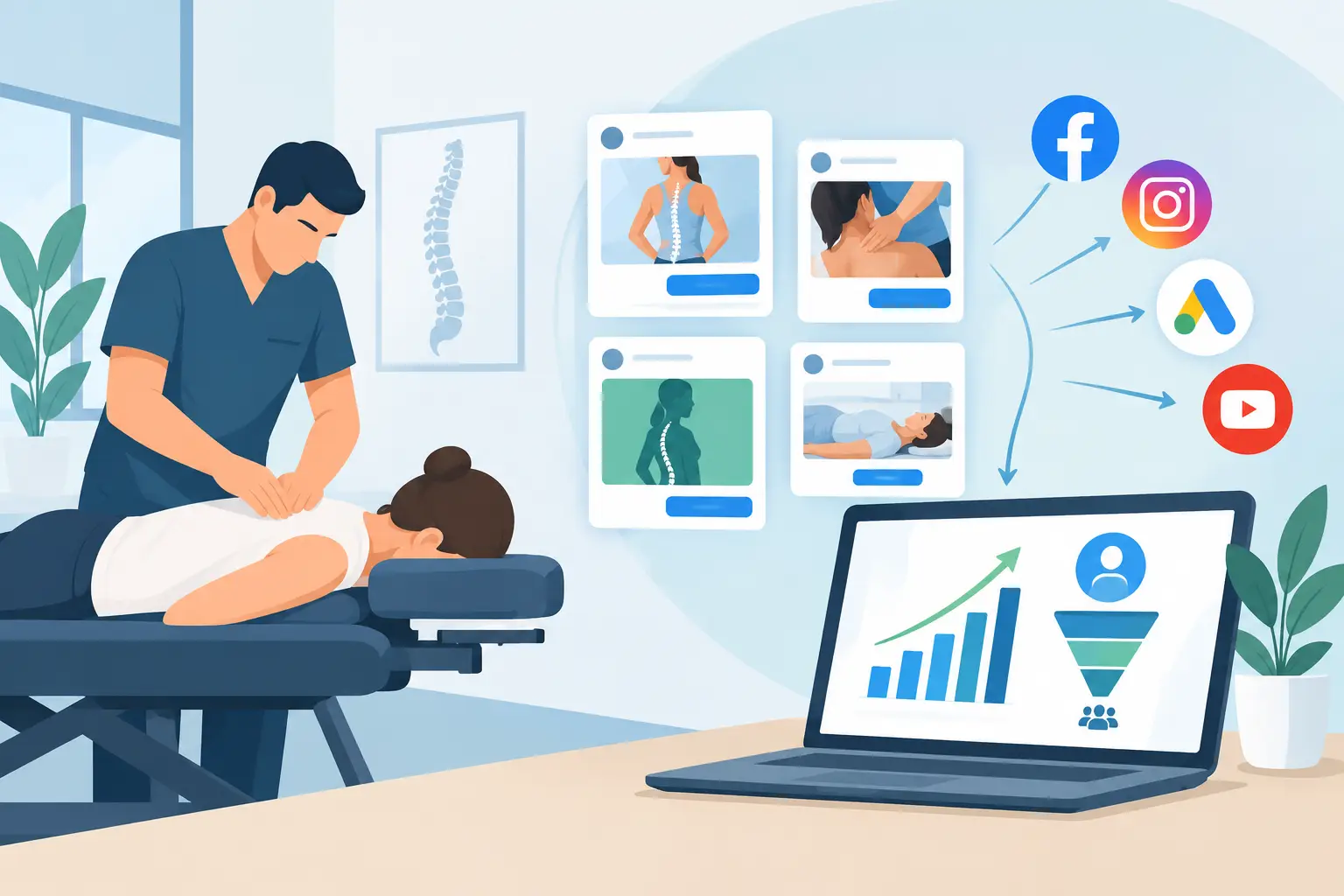
A prospective patient with acute low back pain is not searching for a generic healthcare provider. They are comparing nearby chiropractors, reading reviews, scanning websites for credibility, and deciding who feels capable of helping them now. That is the moment healthcare marketing must win. If your practice is hard to find, looks interchangeable, or creates doubt before a patient calls, the competitor down the street gets the opportunity.
For chiropractic practices, marketing is not a collection of disconnected posts, ads, and monthly reports. It is the operating system behind patient demand. It determines whether your clinic shows up when local intent is highest, whether your message gives people a reason to choose you, and whether a lead becomes a booked appointment instead of another missed call.
Healthcare Marketing Is a Trust-Building System
Healthcare decisions carry more emotional weight than most purchases. A patient may be in pain, frustrated after trying other options, worried about cost, or unsure whether chiropractic care is right for their situation. Before they meet your team, your marketing has already begun answering those concerns.
That means strong healthcare marketing must do more than generate impressions. It needs to build confidence quickly. Your brand, Google Business Profile, website, reviews, educational content, paid ads, and front-desk follow-up should all tell a consistent story: this is a professional, credible practice that understands the patient’s problem and makes the next step clear.
Generic marketing rarely creates that effect. A stock photo, a vague promise of “better health,” and a list of services could describe hundreds of clinics in your city. Patients do not choose the clinic that sounds acceptable. They choose the clinic that feels most relevant, most credible, and easiest to act on.
Your Positioning Must Answer “Why You?”
Every chiropractic market has a default category message: pain relief, wellness, family care, sports injury, auto accidents, or spinal health. Those services may be essential to your practice, but naming them is not positioning.
Positioning gives patients a memorable reason to prefer you. It can come from a defined clinical focus, a distinct patient experience, an established local reputation, advanced expertise, a family-centered approach, or a clear philosophy of care. The right answer depends on your practice model and the demand in your area. A high-volume walk-in clinic should not market itself like a premium corrective-care practice, and a PI-focused practice needs a different conversion path than a pediatric-centered office.
The goal is not to invent a clever slogan. The goal is to make your practice easier to choose.
Dominate the Local Search Moment
Most new-patient demand begins with a local search. People type “chiropractor near me,” search a condition, ask Google Maps for nearby care, or use AI-powered search tools to compare options. If your practice lacks visibility in those moments, your referral network alone has to carry too much of the growth burden.
Local visibility starts with the fundamentals: accurate business information, a complete Google Business Profile, consistent categories, current photos, active review generation, location-specific website pages, and a site that works well on a phone. These are not cosmetic tasks. They are ranking and conversion assets.
A clinic can rank well and still lose leads if the search result looks weak beside competitors. Sparse reviews, outdated images, unanswered questions, and an unclear website experience signal neglect. Patients may never know how skilled you are because they did not feel confident enough to click or call.
Reviews Are Proof, Not a Side Project
Reviews influence both patient decisions and local visibility. More importantly, they reveal the real experience your practice delivers. The best reviews mention details that matter to prospective patients: relief from a specific problem, a caring team, clear explanations, easy scheduling, family-friendly service, or a professional environment.
Create a consistent process for requesting reviews after positive patient interactions. Do not wait for the occasional enthusiastic patient to remember on their own. Train the team on when and how to ask, make the process simple, and respond thoughtfully to feedback. A steady flow of genuine reviews creates more trust than a burst of activity followed by months of silence.
Build a Website That Converts Attention Into Appointments
Your website is not an online brochure. It is your 24/7 new-patient coordinator. Its job is to reduce uncertainty and move the visitor toward a call, form submission, online booking request, or text conversation.
Too many chiropractic websites bury the essentials beneath long clinical explanations and generic wellness language. Patients need fast answers. Who do you help? What problems do you commonly treat? Where are you located? What should a first visit look like? How can they schedule? Put those answers where visitors can see them without hunting.
A high-converting site also needs visual authority. Design affects perceived quality, especially in healthcare. Dated layouts, inconsistent branding, low-quality photos, and cluttered navigation can make an established practice look smaller and less credible than it is. Premium design is not vanity when it increases confidence before a prospect ever speaks to your team.
Educational content still has a role, but it must support conversion. Pages about sciatica, headaches, neck pain, disc issues, pregnancy care, or auto injuries should be written for real patient questions while giving clear next steps. Avoid claims that overpromise outcomes. Specific, responsible language earns more trust than exaggerated guarantees.
Use Paid Ads When Speed Matters
SEO compounds over time. Paid search and social advertising can create immediate visibility, particularly when you are entering a new market, filling provider capacity, promoting a defined service line, or defending territory against aggressive competitors.
Google Ads are often the strongest fit for high-intent demand because patients are actively searching for care. The trade-off is cost and competition. Broad, unmanaged campaigns can spend heavily on irrelevant clicks, weak search terms, or patients outside your service area. Success comes from disciplined keyword targeting, geographic controls, persuasive ad copy, dedicated landing pages, call tracking, and rapid follow-up.
Facebook and Instagram advertising work differently. They can build awareness, promote an offer, and reach people who may not be searching yet. They are especially useful for community visibility, wellness campaigns, patient education, and retargeting website visitors. But social leads often require more nurturing than search leads. If your team expects every social form fill to behave like an urgent Google caller, performance will look disappointing.
The channel is not the strategy. The strategy is matching the channel to patient intent, capacity, margin, and speed-to-lead.
The Front Desk Is Part of Your Marketing Budget
Marketing does not end when a lead arrives. It ends when a qualified patient schedules, shows up, begins care, and has an experience worth talking about. A practice that spends aggressively on ads but responds slowly to calls and forms is paying to send opportunities to competitors.
Track the full path: lead source, contact rate, appointment rate, show rate, new-patient conversion, case acceptance where appropriate, and retention indicators. This is where practice owners discover whether the issue is lead volume or lead handling. Often, the answer is not “we need more leads.” It is “we need to respond faster, communicate better, and make scheduling easier.”
A missed call should trigger a fast callback. A web lead should receive a timely, human response. Your team should know how to explain the first-visit process without sounding scripted or defensive. These operational details have a direct effect on marketing return.
Make the In-Office Experience Reinforce the Promise
Your brand should not disappear once patients walk through the door. The visual quality and clarity of your physical environment either reinforce the confidence created online or weaken it.
Professional signage, patient education posters, spine charts, TV slides, and branded materials can help patients understand their care recommendations while making the office feel established and intentional. They are most effective when they support the conversations your doctors and team already have. Education should clarify, not overwhelm.
This connection matters for retention. Patients who understand the purpose of care, the expected process, and the value of consistency are better equipped to make informed decisions. Your marketing message and in-office education should feel like one practice, not two disconnected experiences.
Measure Growth Beyond Clicks
Clicks, impressions, and followers are useful diagnostics, but they are not the scoreboard. The metrics that matter are qualified new-patient opportunities, booked appointments, cost per acquired patient, show rates, retention, and revenue contribution by channel.
Do not judge a campaign too early or too broadly. Local SEO may take longer to produce momentum but can create durable, lower-cost demand. Paid search may deliver quickly but require ongoing budget discipline. Brand work can be difficult to attribute to one form submission, yet it raises conversion rates across every channel. The best investment mix depends on your local competition, practice capacity, service focus, and growth timeline.
The practices that win do not treat marketing as a monthly expense to tolerate. They treat it as a measurable growth engine to improve. If your clinic is ready to compete for more of the patients already searching in your market, MyChiroPractice can help turn your brand, visibility, and patient journey into a serious advantage.
Your next patient is making a choice before they ever call. Give them clear evidence that your practice is the one worth choosing.